
Celebrating 20 Years in R&D Tax Relief: My Story so Far!
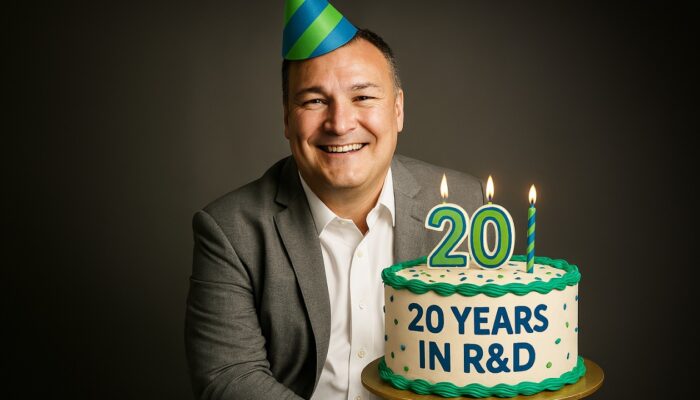
This year marks 20 years since I first became involved in R&D Tax Relief claims.
That sentence alone feels strange to write, not least because when I started, R&D Tax Relief was barely understood, rarely claimed and every single claim I worked on went straight into an HMRC enquiry. More recently, first with COVID, then the Mandatory Random Enquiry Programme and finally the dissolution of the SME scheme, many a mere mortal has given up and moved on!
As a result, there aren’t many voices in this industry who can say that! Whilst I had been working in accountancy from 1996, the R&D Tax Relief legislation was established in 2000 but it wasn’t until 2006, that I was involved in the submission and defence of an actual R&D Tax Relief claim.
Over the last two decades I’ve worked in:
a large regional accountancy practice,
industry (including clinical research and motorsport),
and, since 2013, as founder of Cooden – R&D Tax Specialists.
I’ve seen the regime evolve from something obscure and under‑policed, through a long period of expansion, to the far more tightly controlled (and less rewarding) environment we operate in today.
I’ve also seen:
how poor advice damages good businesses,
how fraud distorts policy responses,
and how legitimate claimants get caught in the crossfire.
Over the next three months, I’m going to share a short series of articles reflecting on:
The early years, when every claim had an enquiry and why that was a good thing
Setting up Cooden in 2013, and what specialising actually means
COVID, fraud, and HMRC’s reaction, including Mandatory Random Enquiries
Where we are now, and what the future of R&D Tax Relief should look like
If you’ve ever made an R&D claim, or decided not to, I hope you’ll find something useful in what follows.
Part One – When Every R&D Claim Had an Enquiry (and Why That Made Me Better)
When I first started working on R&D Tax Relief claims in 2006, there was one certainty:
Every claim faced an HMRC Enquiry.
No exceptions.
At the time, R&D Tax Relief was poorly understood by advisers, accountants and businesses themselves. The guidance was thinner, the case law almost non‑existent, and expectations were rarely aligned.
Those enquiries were uncomfortable for me and the company being enquired into (which was often my employer).
They were slow, they were detailed and yet they were invaluable.
What the Enquiries Taught Me
Each enquiry forced me to confront three realities early in my career:
HMRC don’t enquire because they’re hostile, they enquire because they don’t understand or at least back then, they wanted to educate.
The scientific or technology information matters more than the numbers (although they are still pretty important)
Evidence beats confidence every time!
In these early years an enquiry was mainly focused on education. My experience was that if a company was making a claim for the first time, it would face an enquiry. HMRC would be able to establish whether the claimant’s R&D was genuine and whether the people within/ or without the company making the claim understood how to prepare the claim.
There were specialist units set up across the country, the volume of claims especially from SMEs was low and HMRC had teams at these units who, whilst they weren’t technical or scientific specialists, had bothered to take an interest in particular areas and if a claim came up from a company operating in one of those areas, they would be able to ask intelligent questions. They would guide the company and the advisor on what they were looking for and if any report was lacking, or more likely there was no report, they would seek to understand what the claimant had been doing. It is a far cry from what we have seen in the current climate.
Sometimes they would even increase the value of the claim, or as was the case when I was working in Clinical Research, they would help to get overseas hospitals and universities added to “The Prescribed Bodies list” retrospectively. I always get a little thrill when I look back at that list and see Universities and Hospitals with a registration date of 12th October 2010. Unfortunately, with the changes to the rules on Overseas Subcontracting, that list will be confined to a “404 error” before too long! I may just have to download it for posterity!
During this time, I learned quickly that:
labelling something as “innovative” wasn’t enough,
accounting justifications without technical substance fell apart, and
vague descriptions of “development work” simply didn’t survive questioning.
I will be clear that the claim that I was involved in in accountancy had a very limited technical report and the claims I prepared whilst working in the clinical research business were purely numbers, I was relying heavily on the fact that DTI had issued some guidelines similar to those now found at CIRD 81920.
What I came to understand as I moved from industry and into the world of consultancy was that claims needed:
a clear technological baseline,
genuine scientific and or technological uncertainty, and,
an explanation that a competent professional would recognise as R&D
This was brought home to me, with brutal reality, when I asked an external advisor to support me with the first claim for the motorsport company as it had to be prepared within 2 months of my starting work there and I was out of my depth. The advisor produced an 80-page report, which opened my eyes to what was really required and you know what, yes you’ve guessed it…..
even that faced an HMRC enquiry!
One Definition I’ve Kept Ever Since
Those early years shaped a definition I still use today:
A successful R&D claim is not one that gets paid quickly — it’s one that withstands an enquiry.
And yes, that does align with HMRC policy on talking about “Successful claims”!
That definition has guided every claim, whether in clinical research managing multi‑million‑pound claims, motorsport engineering, or later when I set up Cooden.
In later articles, I’ll come back to why this matters more than ever in today’s compliance environment.
I hope you’ll come back for Part 2 at the end of May!